
Quick Answer:
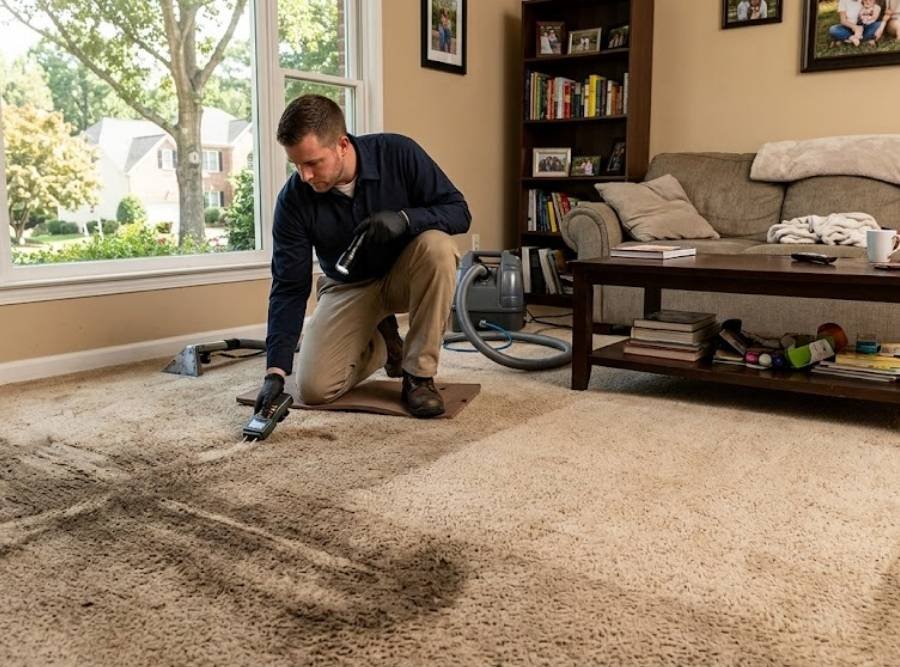
Yes, professional carpet cleaning can often restore carpet that has gone years without maintenance, but the results depend on what has actually happened to the carpet over time. Embedded soil, pollen, pet residue, oils, and many odors can usually be removed through a thorough professional restoration process, while permanent fiber wear, crushed pile, severe staining, and deteriorated padding cannot be reversed. The purpose of professional cleaning is to remove years of accumulated contamination, reveal the carpet’s true condition, and help determine whether restoration or replacement is the better long-term investment.
One of the most common questions we hear from homeowners throughout Kennesaw is whether an old carpet is simply too far gone to save. The concern usually comes after years of postponed maintenance, when the walkways have turned gray or black, the fibers feel rough underfoot, and vacuuming seems to make little difference. Many people assume the carpet has simply reached the end of its life because it no longer looks clean, even immediately after being vacuumed.
In reality, appearance alone tells very little about whether a carpet can still be restored. A carpet that looks severely neglected may still have structurally healthy fibers buried beneath years of embedded soil, while another carpet that appears only slightly dirty may already have permanent wear caused by heavy traffic and abrasion. Without understanding what has changed inside the carpet over time, it is impossible to know whether professional cleaning will produce a dramatic improvement or simply reveal damage that has been hidden beneath years of contamination.
This is one of the biggest misconceptions surrounding older carpet. Homeowners often view every dark traffic lane, every dull area, and every flattened section as “dirt,” assuming it will disappear during cleaning. Professional restoration begins by separating removable contamination from permanent material damage because those two conditions frequently exist together. Cleaning can remove what should not be in the carpet, but it cannot restore fibers that have already been physically worn away through years of use.
For that reason, evaluating neglected carpet is less about asking how dirty it looks and more about understanding why it looks that way. Once the causes are identified, it becomes much easier to determine whether the carpet still has years of useful life remaining or whether replacement is becoming the more practical solution.
Years of Neglect Change More Than the Carpet’s Appearance
Many homeowners picture dirt sitting loosely on top of carpet, much like dust collecting on a hardwood floor. If that were how carpet functioned, years of neglect would simply mean there was more dirt waiting to be extracted. Carpet behaves very differently because it is designed to trap particles deep within the pile until they can be removed through regular maintenance. As professional cleaning is delayed, those particles migrate farther into the carpet structure, where ordinary vacuuming becomes progressively less effective.
The process begins with ordinary household contamination. Shoes track in fine mineral soil, red Georgia clay, pollen, organic debris, and roadway dust. Inside the home, body oils, cooking residue, pet dander, skin cells, and microscopic fibers settle into the carpet every day. Initially these contaminants remain relatively loose, but over time oils begin coating the fibers and binding additional soil to their surfaces. Instead of resting on top of the carpet, contamination becomes integrated into the pile itself. As that buildup continues, the carpet experiences something far more damaging than simple discoloration. Every footstep presses hard mineral particles against thousands of individual fibers, gradually scratching their surfaces and reducing their ability to reflect light evenly. This explains why neglected traffic lanes often remain dull even after significant amounts of soil have been removed. Professional extraction can eliminate years of accumulated contamination, but it cannot rebuild fiber surfaces that have been permanently altered through mechanical abrasion.
Understanding this progression changes the entire conversation about restoration. The objective is not to promise that every neglected carpet will look brand new. The objective is to remove everything that should not be present so the remaining condition of the carpet can be evaluated honestly. In many cases, homeowners discover that much more of their carpet is recoverable than they expected once years of embedded contamination have been extracted.
Why Two Carpets That Look Equally Dirty Can Produce Completely Different Results
One of the most surprising aspects of professional carpet restoration is that two carpets with nearly identical appearances can respond very differently during cleaning. Homeowners naturally assume that carpets showing the same level of discoloration will produce similar results, but experienced restoration professionals know that appearance alone rarely tells the whole story. The history of the carpet often matters far more than the amount of visible soil.
Consider two homes in Kennesaw. One carpet may be only six years old but located in a busy family room where children, pets, indoor shoes, frequent entertaining, and years of postponed maintenance have subjected it to constant traffic. Another carpet may be fifteen years old in a lightly used guest bedroom that has experienced very little wear despite receiving minimal professional cleaning. Before restoration, the newer carpet may actually appear worse than the older one, yet after professional cleaning the bedroom carpet may retain far more of its original appearance because its fibers have experienced much less physical abrasion.
This is why professional evaluation focuses heavily on traffic patterns rather than isolated stains. Walkways, entryways, stairs, and transition areas reveal where abrasive soil has repeatedly compressed the pile, where oils have accumulated, and where years of foot traffic have gradually changed the carpet’s physical structure. Areas protected beneath furniture provide an equally valuable comparison because they often preserve the carpet’s original color and pile condition. Comparing these protected areas with exposed traffic lanes helps distinguish removable contamination from permanent wear.
Every carpet therefore tells its own story. Fiber type, construction quality, traffic levels, maintenance history, pet activity, moisture exposure, and household habits all influence how much restoration is realistically possible. That is why responsible professionals avoid guaranteeing dramatic visual improvements before understanding the condition of the carpet itself.
Kennesaw’s Environment Quietly Accelerates Carpet Contamination
The environment surrounding a home plays a much larger role in carpet deterioration than many homeowners realize. Throughout Kennesaw, carpets are continually exposed to fine particulate contamination from seasonal pollen, red Georgia clay, roadway dust, and organic material carried indoors from surrounding landscapes. These contaminants rarely become noticeable immediately because carpet is designed to conceal soil within the pile rather than allowing it to remain visible on the surface.
Spring presents one of the greatest challenges for homes throughout neighborhoods such as Legacy Park, the Kennesaw Mountain area, Historic Downtown Kennesaw, Butler Creek, and communities along Stilesboro Road and Jiles Road. Heavy pollen produced by mature oak, pine, and hardwood trees settles onto clothing, pets, outdoor furniture, and vehicles before eventually making its way indoors. While much of it remains invisible to homeowners, it contributes steadily to the carpet’s overall soil load and becomes increasingly difficult to remove as oils bind the particles deeper into the fibers.
Summer introduces a different set of conditions. Afternoon thunderstorms frequently track red Georgia clay into entryways, hallways, and family rooms where wet mineral particles dry within the carpet pile. At the same time, Georgia’s humidity slows evaporation after minor spills and makes existing odor sources more noticeable. Organic residue that remained relatively unnoticed during cooler months can suddenly produce stale or musty odors once humidity increases, leading homeowners to believe the weather created the problem when it actually exposed contamination that had accumulated over many years.
Rapid residential growth throughout portions of Kennesaw also contributes additional fine dust from nearby construction activity. These microscopic particles may never be obvious individually, but together they increase the abrasive soil load trapped within the carpet. Combined with heavy family traffic, indoor shoe use, and postponed professional maintenance, they accelerate the gradual transition from removable contamination to permanent fiber wear.
Professional Cleaning Begins With Evaluation, Not Equipment
One of the biggest differences between professional carpet restoration and ordinary cleaning is that restoration starts with evaluation rather than immediately choosing a cleaning method. Homeowners often focus on whether hot water extraction, low-moisture cleaning, or another process will be used, but experienced professionals first determine what condition the carpet is actually in. Without understanding the material itself, selecting equipment or chemistry becomes little more than guesswork.
A proper evaluation considers far more than visible stains. Fiber type, carpet age, construction quality, traffic patterns, moisture history, odor sources, pet activity, previous cleaning attempts, and the condition of the backing and padding all influence how the carpet is expected to respond. Even something as simple as comparing exposed walkways with carpet beneath furniture can reveal whether discoloration is primarily caused by removable soil or permanent wear.
This evaluation also helps establish realistic expectations before restoration begins. Some carpets will respond dramatically because years of embedded contamination have hidden otherwise healthy fibers. Others will become significantly cleaner while continuing to show traffic lanes, crushed pile, or permanent staining because those conditions represent physical changes to the carpet rather than dirt alone. Honest evaluation protects homeowners from unrealistic expectations while allowing them to make informed decisions about whether cleaning, repair, or replacement provides the greatest long-term value.
Ultimately, the question is not whether professional carpet cleaning can fix every neglected carpet. The real question is how much of the carpet’s condition is still recoverable once years of accumulated contamination have finally been removed. That answer can only be determined by understanding the carpet as a complete flooring system rather than judging it solely by how dirty it appears on the surface.
What a Professional Restoration Process Can Actually Remove
When homeowners hear the phrase “deep carpet cleaning,” they often picture one machine passing over the carpet until the water looks dirty. Professional restoration is considerably more involved because heavily neglected carpet rarely contains just one type of contamination. Years of embedded mineral soil, body oils, food residue, pollen, pet dander, detergent buildup, and microscopic organic material each respond differently during the cleaning process. Successfully restoring an older carpet requires understanding how those contaminants behave rather than simply applying more water or stronger cleaning chemicals.
The first objective is removing as much dry particulate soil as possible before introducing moisture. Fine mineral particles act like abrasive grit, and once they become wet, they can form a muddy residue that is more difficult to extract efficiently. After thorough dry soil removal, appropriate preconditioning solutions help loosen oils and bonded contaminants that ordinary vacuuming cannot reach. Depending on the carpet’s condition, controlled agitation may be used to distribute cleaning agents evenly throughout the pile without unnecessarily stressing the fibers.
Hot water extraction then becomes the primary method for removing suspended contamination from deep within the carpet. Contrary to what many homeowners believe, the goal is not simply to “steam clean” the surface. Effective extraction removes dissolved soils, cleaning solutions, allergens, and moisture from the carpet while leaving as little residue behind as possible. The quality of the extraction process often determines whether the carpet dries properly and stays cleaner longer after the restoration is complete.
A professional restoration process is designed to recover years of accumulated contamination while protecting the carpet’s remaining integrity. More aggressive cleaning is not always better. Once removable soil has been extracted, continuing to overwet the carpet or repeatedly applying chemicals will not reverse permanent wear and may actually create unnecessary drying challenges or residue problems.
Why Some Stains Improve While Others Become Permanent
One of the most important conversations during a carpet evaluation involves setting realistic expectations about stains. Many homeowners understandably group every dark spot into the same category, assuming all discoloration is simply dirt that has accumulated over time. In reality, soil and staining are two very different conditions, and each requires a different restoration approach.
Soil exists on or around the carpet fibers and can often be suspended and removed through professional extraction. Stains occur when a substance chemically alters the fiber itself or permanently changes its color. Coffee, wine, certain food dyes, pet urine, rust, furniture stains, bleach, and some medications can create reactions that remain even after every trace of removable contamination has been extracted. In those situations, the carpet may become dramatically cleaner while individual stains remain visible because the fiber itself has changed.
Time also affects stain recovery. A spill addressed within hours behaves very differently from one that has remained in the carpet for several years. Oxidation, repeated DIY cleaning attempts, inappropriate household chemicals, and heat can permanently alter many staining materials, reducing how much visual improvement is possible. Professional stain treatment can often improve these areas significantly, but responsible restoration professionals should never promise complete removal before understanding the chemistry involved.
The same principle applies to recurring spots that seem to disappear immediately after cleaning before gradually returning. This phenomenon, commonly known as wicking, occurs when residue remaining deeper in the carpet or backing migrates upward as moisture evaporates. Correcting the problem requires addressing the source below the visible surface rather than repeatedly cleaning the top of the carpet.
Odors Often Tell a Different Story Than Appearance
A carpet’s appearance and its odor do not always reflect the same underlying condition. Some neglected carpets look heavily soiled but have very little odor because the contamination consists primarily of dry particulate soil. Others appear relatively clean while producing persistent musty or pet-related odors that become especially noticeable during Kennesaw’s humid summers. Understanding where those odors originate is critical because the solution depends on how deeply the contamination has migrated through the carpet system.
General stale odors often improve dramatically after years of embedded organic residue, oils, dust, and allergens are removed through professional extraction. Once those materials are eliminated and the carpet dries properly, many rooms immediately feel fresher because the primary odor source has been removed rather than temporarily masked with fragrances or deodorizing powders. This is one reason professional cleaning often produces improvements homeowners did not expect, even when visual wear remains.
Pet-related odors require a more detailed evaluation because liquid contamination frequently extends beyond the visible carpet fibers. Urine can move through the backing into the carpet pad and, in severe situations, even affect the subfloor beneath. Surface cleaning alone may reduce the smell temporarily while leaving contamination below that becomes noticeable again whenever humidity rises. In these cases, successful odor remediation may involve targeted treatment, localized pad replacement, or additional restoration procedures beyond routine carpet cleaning.
Musty odors should also be interpreted carefully. Many homeowners immediately assume that any stale smell indicates mold growing inside the carpet. While mold is certainly possible after prolonged moisture exposure, musty odors can also result from old spills, detergent residue, embedded organic debris, elevated indoor humidity, or carpet padding that has retained moisture over time. Identifying the actual source is far more valuable than treating every odor as the same problem.
When Cleaning Stops Being the Best Investment
One of the responsibilities of an experienced restoration professional is knowing when cleaning is no longer the most practical recommendation. Although professional extraction can dramatically improve many neglected carpets, there comes a point where structural deterioration outweighs the benefits of additional restoration. Recommending cleaning simply because it is available does not always serve the homeowner’s best interests.
Permanent fiber abrasion is one of the most common limitations. After years of heavy foot traffic, embedded grit gradually wears away the microscopic surfaces of the fibers, reducing their ability to reflect light evenly. Even after every removable contaminant has been extracted, traffic lanes may continue appearing darker because the material itself has physically changed. Cleaning reveals the carpet’s true condition, but it cannot recreate fiber that has already been worn away.
Other conditions point more clearly toward replacement than restoration. Widespread delamination, deteriorated backing, severe rippling, extensive bleaching, flood or sewage contamination, widespread mold resulting from prolonged water intrusion, or carpet padding saturated with years of pet urine often require more extensive corrective work than professional cleaning alone can provide. Attempting repeated restorative cleanings in these situations may increase costs without producing meaningful long-term improvement.
This is why honest recommendations matter. Some homeowners are surprised to learn their neglected carpet still has several years of useful life remaining after restoration. Others discover that replacement will ultimately provide greater value than investing repeatedly in material that has already reached the end of its service life. A thorough evaluation allows those decisions to be based on evidence rather than assumptions.
Why Trying Professional Cleaning Before Replacement Often Makes Financial Sense
Replacing carpet is one of the larger interior flooring expenses many homeowners face, particularly when multiple rooms, stairs, or large open living spaces are involved. Because of that investment, determining whether existing carpet can be restored first is often a financially responsible decision. Even when replacement eventually becomes necessary, understanding the carpet’s actual condition helps homeowners avoid replacing flooring prematurely based solely on appearance.
Professional restoration frequently produces the greatest value in homes preparing for sale, rental turnovers, move-in projects, or major remodeling decisions. Removing years of accumulated soil, improving indoor freshness, reducing allergens, and restoring color where the fibers remain healthy can substantially improve the appearance of the home without immediately committing to new flooring. In many situations, homeowners gain additional years of service from carpet they originally believed had no remaining value.
Bedrooms, guest rooms, home offices, and other lower-traffic areas often benefit particularly well because they experience far less abrasion than central family spaces. Even if hallways or living rooms eventually require replacement, successfully restoring the remaining carpet can reduce renovation costs while preserving flooring that still performs well structurally. This selective approach often provides better long-term value than replacing every room simply because one portion of the home has deteriorated.
The decision should ultimately focus on return on investment rather than emotion. A carpet that appears embarrassing today may still respond exceptionally well to professional restoration, while another that seems only moderately worn may have hidden structural issues that justify replacement. Allowing the carpet to be evaluated before making that decision removes much of the uncertainty from the process.
Restoration Is About Revealing the Carpet’s True Condition
The purpose of professional carpet cleaning is not to promise miracles or convince homeowners that every neglected carpet can be made to look brand new. Restoration is a process of removing years of accumulated contamination so the carpet’s actual condition can finally be seen. Once embedded soil, oils, allergens, residue, and odor-producing materials have been extracted, it becomes much easier to distinguish normal aging from irreversible material failure.
Many carpets throughout Kennesaw have never received professional cleaning despite years of daily use, spring pollen, red Georgia clay, humid summers, pets, and busy family traffic. In many of those homes, the greatest problem is not the age of the carpet but the accumulation of contamination that has slowly hidden its remaining condition. Professional restoration frequently uncovers healthier fibers than homeowners expected, allowing them to postpone replacement while improving appearance, cleanliness, and indoor comfort.
