Quick Answer:
If your carpet still smells moldy after a leak, the odor is usually being caused by moisture that remains trapped beneath the carpet rather than the carpet fibers themselves. Successfully eliminating the smell requires finding and drying the hidden source of the moisture, addressing any microbial growth that has developed, and determining whether the carpet, padding, and subfloor can be restored before the problem becomes permanent.
Few things are more frustrating than cleaning up a water leak, waiting for the carpet to dry, and then discovering that the room still smells damp days later. At first, many homeowners assume the carpet simply needs another cleaning or that the odor will disappear on its own. They sprinkle baking soda, spray air fresheners, rent a carpet cleaning machine, or open the windows hoping fresh air will solve the problem. Sometimes the room smells better for a few hours, but before long the musty odor returns, often becoming even stronger after it rains or when the air conditioner begins running.
We’ve seen this situation throughout Powder Springs, from established neighborhoods near Historic Downtown and Lost Mountain to newer communities along New Macland Road, Richard D. Sailors Parkway, and Echo Mill. Whether the original water came from a burst supply line, an overflowing appliance, a roof leak after one of Cobb County’s summer thunderstorms, or a plumbing issue hidden behind a wall, homeowners often describe the same experience. The visible water is gone, the carpet no longer feels soaking wet, yet something in the room still smells wrong. That lingering odor causes understandable concern because people immediately begin wondering whether mold is growing beneath the carpet or whether replacing the entire floor is their only option.
One of the biggest misconceptions surrounding water-damaged carpet is that the smell comes from the carpet fibers themselves. In reality, the odor is often only the symptom of a much larger moisture problem developing below the visible surface. By the time a carpet begins producing that familiar musty smell, moisture has frequently remained trapped somewhere long enough for bacteria or mold to begin affecting the surrounding materials. Eliminating the odor therefore isn’t simply a matter of making the carpet smell better. The real objective is identifying why the odor developed in the first place and correcting the conditions allowing it to continue.
That’s why our first question after any leak isn’t, “How do we deodorize the carpet?” It’s “Where is the moisture still hiding?” Until that question is answered, odor treatments alone are often temporary because they address what homeowners can smell rather than what’s actually happening beneath the floor.
Why Your Carpet Can Smell Worse Days After the Leak
One of the most confusing aspects of water damage is that the odor often doesn’t appear immediately. In fact, many homeowners tell us the room smelled perfectly normal during the first day or two after the leak. They cleaned up the standing water, ran a few fans, and assumed everything had dried successfully. Then several days later, seemingly without warning, the room developed the stale, musty odor that people commonly associate with mold.
That delayed odor is not unusual. Water behaves very differently beneath a carpet than it does on top of one. While the exposed carpet fibers begin drying almost as soon as air starts circulating through the room, much of the moisture has already moved downward into the carpet pad and, in many cases, into the subfloor below. Those materials receive far less airflow than the visible surface, allowing moisture to remain trapped even after the carpet itself begins feeling dry to the touch. A homeowner walking barefoot across the room may honestly believe the floor has completely dried while significant moisture still exists only a fraction of an inch below.
As that hidden moisture remains in place, microscopic organisms naturally present in the environment begin responding to the conditions around them. Mold doesn’t suddenly appear because water touched the carpet once. It develops when moisture remains available long enough for microbial growth to begin multiplying within porous materials. At the same time, bacteria feeding on organic material can produce gases responsible for the earthy, musty odors homeowners notice first. In many situations, the smell appears before any visible mold can actually be seen because the growth is occurring underneath the carpet or within the padding where homeowners cannot easily inspect.
One thing we’ve consistently noticed throughout Powder Springs is that homeowners often become reassured too quickly because the room appears to be improving. The leak has stopped, the visible water has disappeared, and the carpet looks almost normal again. Unfortunately, moisture doesn’t always follow the same timeline as appearance. During Georgia’s humid summers, especially after extended periods of rain, elevated indoor humidity slows evaporation even further. A room that seems dry on the surface may still contain enough trapped moisture beneath the carpet to allow odor-producing microbial activity to continue for days or even weeks if proper structural drying never took place.
Why the Carpet Can Feel Dry While the Padding Is Still Wet
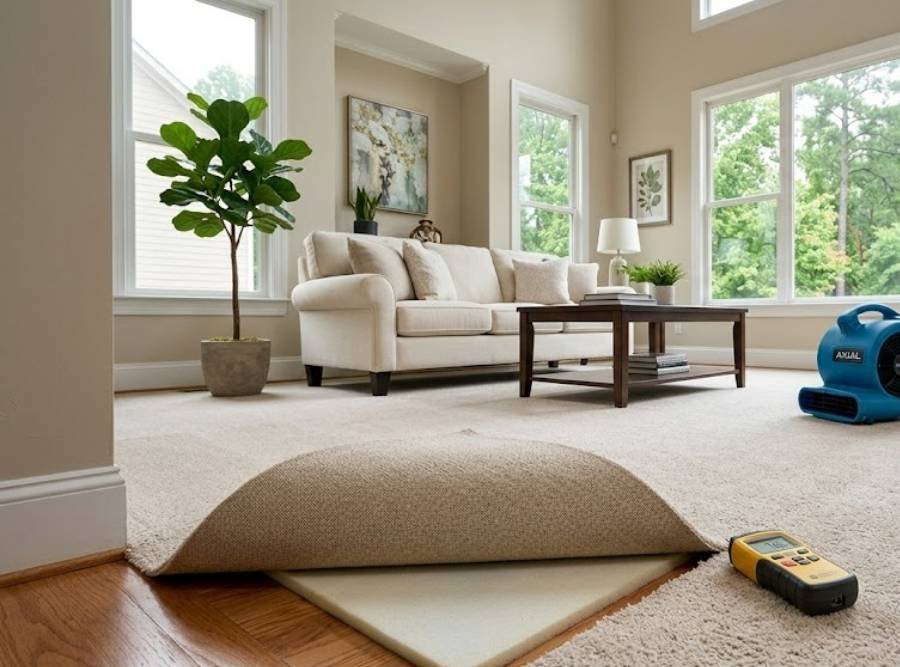
Perhaps the biggest surprise for homeowners after a water leak is discovering that a carpet can appear completely normal while the materials underneath remain saturated. This happens because carpet is not a single layer. The flooring system includes the carpet fibers you see every day, the backing that holds those fibers together, the carpet pad underneath that provides cushioning, and finally the subfloor supporting everything above it. Water doesn’t stop at the visible surface. Gravity immediately begins pulling it through every layer it can reach.
The carpet pad is often the biggest challenge during water damage restoration because it’s specifically designed to absorb and cushion weight. Those same characteristics also allow it to retain significant amounts of water. Once saturated, many types of carpet padding dry much more slowly than homeowners expect because very little air naturally circulates beneath the carpet. Running ceiling fans or opening windows may improve conditions above the floor, but they do relatively little for moisture trapped underneath unless the drying process is specifically designed to remove it.
We’ve responded to homes where the carpet itself tested relatively dry while the pad underneath remained heavily saturated several days after the original leak. In those situations, deodorizing the carpet alone wouldn’t solve the problem because the odor wasn’t originating from the fibers people could see. The source remained hidden beneath the surface where moisture continued supporting bacterial growth and, if left long enough, mold amplification. Until the trapped moisture is extracted or the affected materials are properly dried or replaced, the odor frequently returns regardless of how many cleaning products are applied to the visible carpet.
The subfloor also deserves careful attention because different materials respond differently to prolonged moisture exposure. Wood subfloors may begin absorbing water, expanding, and eventually weakening if moisture remains trapped against them for extended periods. Adhesives securing the carpet can lose strength, baseboards may begin swelling, and nearby drywall can gradually wick moisture upward through capillary action. What initially appears to be a simple carpet odor therefore has the potential to become a much broader restoration issue if the moisture pathway isn’t identified and corrected early.
Why Air Fresheners, Baking Soda, and Shampooing Usually Don’t Solve the Problem
When a room begins smelling musty after a leak, it’s completely understandable that homeowners reach for the products already sitting in the pantry or cleaning cabinet. Baking soda has long been promoted as an odor absorber. Vinegar is often recommended throughout the internet as a natural cleaner. Carpet deodorizers promise fresh scents, while rental carpet cleaning machines appear to offer an affordable solution that can be completed in a single afternoon. The problem is that nearly all of these approaches focus on the odor itself rather than the moisture creating it.
One of the most common mistakes we encounter is assuming the smell means the carpet simply needs another cleaning. In reality, shampooing an already damp carpet often introduces additional moisture into materials that haven’t finished drying from the original leak. If that cleaning process isn’t followed by sufficient extraction and dehumidification, the carpet pad may actually remain wet even longer than before. Instead of accelerating recovery, repeated shampooing sometimes extends the conditions that allowed the odor to develop in the first place.
Air fresheners and deodorizers present a different challenge. They may temporarily overwhelm unpleasant odors with fragrance, making the room feel cleaner for a short period of time, but they don’t eliminate the microbial activity producing the smell. Once the fragrance dissipates, the musty odor often returns because the underlying moisture remains unchanged. Baking soda can help absorb certain surface odors under the right circumstances, but it cannot dry a saturated carpet pad, remove hidden moisture from a wood subfloor, or stop microbial growth developing beneath the flooring system.
This is why we approach persistent carpet odors differently than ordinary cleaning concerns. Rather than asking which product might cover the smell, we begin by determining whether moisture still exists below the surface and whether the affected materials remain structurally sound. Only after understanding the extent of the water intrusion can we determine whether professional drying, odor remediation, limited pad replacement, or more extensive restoration is the appropriate next step.
Can the Carpet Be Saved, or Does It Need to Be Replaced?
One of the first questions homeowners ask after discovering a persistent moldy smell is whether the carpet can be saved. The honest answer depends on several factors, including where the water came from, how long the materials remained wet, and whether microbial growth has spread beyond the carpet fibers into the padding or structural materials below. There isn’t a single rule that applies to every situation because every water loss behaves differently.
For example, a clean water leak from a broken supply line that is discovered and dried quickly presents a very different restoration opportunity than a toilet overflow, sewage backup, or dishwasher discharge that has contaminated the flooring. In the restoration industry, these situations are categorized based on the water source because contamination levels directly influence what materials can safely be restored. A Category 1 water loss involving clean water often allows more restoration options if drying begins immediately, while Category 2 or Category 3 water losses involving contaminated water may require removing affected materials to protect the home’s indoor environment.
Timing is equally important. During the first day after a leak, the focus is on removing as much moisture as possible before it migrates deeper into the flooring system. Once moisture remains trapped beyond roughly 24 to 48 hours—especially during Powder Springs’ warm, humid weather—the likelihood of microbial growth increases significantly. That doesn’t automatically mean the carpet is ruined, but it does mean the restoration process becomes more complex because attention must shift from simply drying materials to evaluating whether contamination has developed.
We’ve restored many carpets that homeowners assumed needed replacement simply because they smelled musty after a leak. We’ve also encountered situations where replacing only the carpet pad solved the problem because the carpet itself remained in good condition while the padding had absorbed the majority of the moisture and odor. Conversely, there are times when both the carpet and the pad have been affected beyond practical restoration, particularly if contaminated water or prolonged moisture exposure has compromised the backing, adhesives, or subfloor. Determining the difference requires inspection and moisture testing rather than guesswork.
When Carpet Cleaning Helps—and When It Doesn’t
Many homeowners assume that if the carpet smells bad, professional carpet cleaning should eliminate the odor. Sometimes that’s true, but only when cleaning is addressing the actual source of the problem. If the musty smell is being caused by residual soil, light organic contamination, or surface-level odor after the flooring has already been completely dried, professional cleaning can often produce excellent results. However, cleaning alone cannot correct moisture that’s still trapped beneath the carpet or inside the padding.
This distinction is one of the most important concepts homeowners can understand. Carpet cleaning is designed to remove soils, stains, and contaminants from the visible carpet fibers. Water damage restoration is designed to remove moisture from the entire flooring system, including areas that can’t be seen without specialized equipment or inspection. Although these services often work together, they are not interchangeable. Cleaning a wet carpet without resolving the underlying moisture issue is much like repainting a wall while the pipe leaking behind it continues to drip.
One of the most common frustrations we hear is, “I already had the carpet cleaned, but the smell came back.” In many of those situations, the cleaning itself wasn’t necessarily ineffective. The odor simply originated somewhere cleaning couldn’t reach. Moisture trapped within the carpet pad, absorbed into the wood subfloor, or lingering around the tack strip can continue producing odor even after the carpet fibers themselves have been professionally cleaned. Until those hidden moisture sources are corrected, the smell often returns whenever humidity rises or the HVAC system begins circulating air through the room.
Professional restoration focuses on the entire moisture pathway rather than the visible carpet alone. Moisture meters, hygrometers, and moisture mapping allow technicians to identify where water migrated, how deeply it penetrated, and whether structural drying has been successful. Once those conditions have been corrected, cleaning and odor remediation become far more effective because the source of the odor has finally been eliminated rather than temporarily concealed.
Why Powder Springs’ Climate Makes Odor Problems More Persistent
Powder Springs presents environmental challenges that many homeowners don’t fully appreciate until they experience water damage firsthand. The region’s hot summers, frequent afternoon thunderstorms, and naturally elevated humidity slow evaporation compared with drier climates. While standing water may disappear relatively quickly, the moisture trapped inside porous materials often remains much longer because the surrounding air already contains significant amounts of moisture.
Homes throughout neighborhoods like Lost Mountain, Echo Mill, Vineyard Gate, and along New Macland Road frequently experience these seasonal humidity challenges. Properties surrounded by mature trees receive additional shade that can reduce natural drying, while finished basements, crawl spaces, and rooms with limited airflow often retain moisture long after the original leak has been repaired. Even air conditioning, although essential for comfort, can create temperature differences that affect how moisture moves and evaporates throughout the home.
Heavy furniture introduces another factor many homeowners overlook. Sofas, beds, entertainment centers, and large cabinets restrict airflow directly over portions of the carpet, allowing moisture beneath those areas to remain trapped longer than exposed sections of the room. It’s not unusual for one portion of a carpet to dry normally while another area hidden beneath furniture continues holding enough moisture to produce odor. That’s why restoration often involves temporarily moving furnishings and creating controlled airflow patterns rather than simply placing a fan in the doorway.
Humidity also explains why some homeowners notice the odor becoming stronger after rainy weather or when the house has been closed for several days. As relative humidity increases, materials that previously seemed dry can temporarily release more odor into the surrounding air. People sometimes assume the leak has returned, when in reality the changing environmental conditions are simply making an existing moisture problem more noticeable. Identifying and correcting that hidden moisture source prevents the odor from repeatedly returning every time weather conditions change.
Restore the Moisture Problem, Not Just the Smell
When a carpet develops a moldy smell after a leak, it’s natural to focus on the odor because that’s the problem everyone notices first. But after years of helping homeowners recover from water damage, we’ve learned that persistent odors are rarely the real problem—they’re a warning that something beneath the surface still needs attention. Eliminating the smell without eliminating the moisture only delays the restoration that eventually becomes necessary.
At Restore N Refresh, we approach water-damaged carpet differently than routine carpet cleaning. Our goal isn’t simply to make the room smell fresher for a few days. We evaluate where the water traveled, determine whether moisture remains within the carpet pad or subfloor, assess whether the affected materials can be safely restored, and recommend the solution that addresses the underlying cause rather than masking the symptoms. That process helps homeowners avoid unnecessary replacement when restoration is possible while also recognizing situations where damaged materials should be removed before larger problems develop.
Many carpets in Powder Springs can be successfully restored when water damage is addressed promptly and thoroughly. Early extraction, proper structural drying, controlled dehumidification, and professional evaluation often prevent a relatively small leak from becoming a major restoration project. Waiting for the odor to disappear on its own, however, rarely improves the situation because moisture problems generally become more expensive—not less—as time passes.
If your carpet still smells musty after a plumbing leak, overflowing appliance, storm-related intrusion, or other water event, Restore N Refresh can determine where the moisture remains and whether your carpet, padding, and subfloor can be restored. By treating the source of the odor instead of simply covering it up, we help homeowners protect their flooring, improve indoor air quality, and avoid more extensive repairs whenever possible.
